TUvé Interactive Internet Television? - It was and so much more!
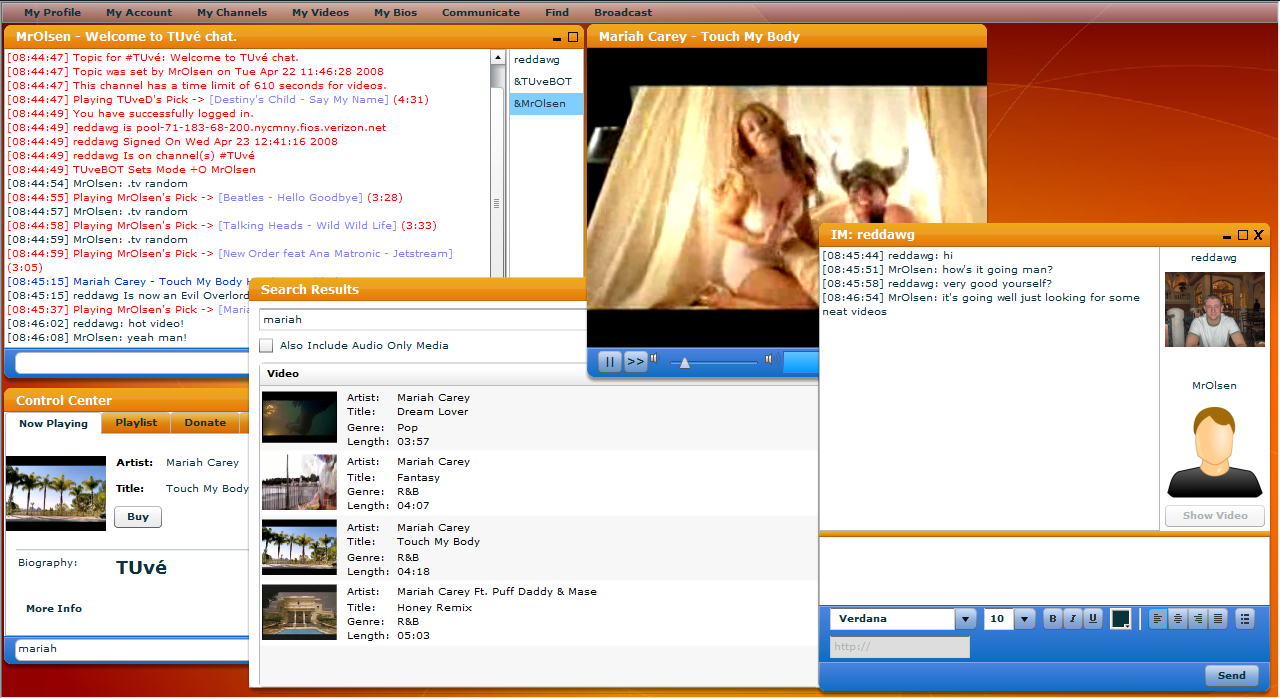
TUvé Interactive Internet Television?
It should have been, could have been, but wasn’t!
It has been seven years since this project was shelved, securing a spot in my top five hardest decisions that I have ever had to make. Many times I have considered bringing it back to life, but the same reasons it was shelved remained, so it continued to stay.
Now that we have evolved culturally in how we coexist with the internet, it is common for just about every demographic to use the internet socially due to the explosion of social networking. With that said, it is time for me to share the story of TUvé, and just maybe your feedback will help me decide if now is the time to breathe new life into it.
TUvé was unlike any other project I have done because it was not a project at all — it was a cultural experience. For you to fully understand what it was, you need to know what it wasn’t, and that is where this journey begins.
What TUvé Wasn’t
While I can’t say TUvé wasn’t a success — it was, in its own right — it did, however, manage to fail to reach a tipping point. TUvé was not something that could be clearly defined, which is why I believe it ultimately failed. Some may disagree with this, but we will get into that later.
TUvé, with its slogan “Like TV, Only Better!”, did anything but let you know what it was. TUvé was not a better television — television was only one small component. There is nothing harder than trying to explain to someone something they have never seen before, so we tried to build on what people already knew. Circa 2007, the internet streaming market was not well defined and had limited competition. Sure, there was YouTube — at the ripe old age of two — with a nice video library, and a few one-to-one streaming services like Skype. However, video was just one component of what we did, and because we did so much more, there was no easy buzzword to throw out where you would say you get it.
As you can see, having nothing to compare it to made it hard to explain what it was — honestly, even I couldn’t explain it well in my 30-second elevator pitch. The easiest part to explain was that we were interactive internet television, which most people interpreted as internet television with a social experience (the interactive part). So leaving people to understand it as that made it easy for someone to say “cool, let me check it out,” or pass, thinking they had no time to watch video with a group of people online. This same understanding made it even more challenging when I solicited investors, to have them fully grasp what it was and what potential it had.
Directly from our website, which launched February 1, 2008, this is how we tried to explain it so that it was easy to understand and pique your interest.
How TUvé Works
What is TUvé?
TUvé (pronounced too-vey) is like TV, only better. It is an online shared video experience where we combine the usefulness of chat with the power of synchronized video. Now you can do two things you love at once!
Why TUvé?
When was the last time you sent a video link to one of your friends? Then another? 18 links later you ask them what they think about the one you’re watching and they still haven’t seen the first one. Thus, TUvé was born. Now you can show all your friends videos and know they’re watching the same thing you are.
How does it work?
TUvé works by allowing users together as a whole to express their taste in videos by inserting channel-permitted videos into their queue. A round-robin system ensures everyone gets to queue a video for other people in the channel to see.
The Power Of TUvé?
TUvé gives you control. Channels can have limits based on time, ratings, genre (live shows, music videos, anime, documentaries, etc.), user-enabled queues, and/or exclusive content.
What does TUvé stand for?
Truth, Justice, and the American Way. Seriously, though, it stands for TCA and Ubu’s Video Experience. The “e” eventually became “é” because “too-vee” doesn’t sound nearly as pretentious as “too-vey”.
Who are we?
Some call us Ubix Corp. Others call us the magical liopleurodon on the way to Candy Mountain. We develop Ubixquitous Technology: that which allows all things to work together better. We also steal kidneys from unsuspecting Unicorns.
So there you have it: our failure was our inability to easily explain what we did, preventing us from attracting new users. This left us short of the critical mass we needed to keep it moving along far enough to bring on investors and ensure it would be self-sustaining.
So Then What Is TUvé And How Did It Start?
For something that evolved into so much, it did not start in a think tank; it didn’t even start on a whiteboard — it started as a peace offering. You see, before TUvé there was uBixOS — an operating system project I started several years earlier — which ended in a breakup that was only slightly overshadowed by Brad Pitt’s breakup with Jennifer Aniston, but this is a story for another day. Having not spoken to my best friend — the one I lost in the collapse — for maybe a year or a little more, I squelched my ego and made a few attempts to reconnect. With a little persistence — or maybe just some luck — I finally got a response: not quite the response I was looking for, but a response nonetheless, and that was good enough for me. So what was the response, you ask? I unfortunately no longer have the original e-mail, but it went something like this: “You know what would be nice? My girlfriend and I like to watch videos together while we’re apart and you know what sucks? There is no easy way for us to watch it in sync as if we were watching TV together on the couch — we have to do a 3, 2, 1 play so that we can watch something together.” Yes, it really was a very short and straightforward e-mail. Now I wasn’t sure if this was intended to be a challenge and I was supposed to scour the internet for a solution, or just say that his predicament sucked. But challenge accepted! Who wouldn’t fight to get back a lost friendship? Plus, I love projects.
Taking our backgrounds into consideration, I knew if there was a solution on the internet, he would have already found it. I mean, he is the one I’d go to for answers — he is my modern-day equivalent of Cortana. So just like anyone who would be excited to hear from a long-lost friend, I jumped right into it to keep the conversation going. Now I came from a background of operating system development — I wrote memory managers, drivers, message-passing interfaces — I knew nothing of application design, let alone video streaming, but that wouldn’t deter me. Everything was flipped: he was the one who wrote the GUI and application framework, but it turned out solving this problem may have just required the opposite skills from what you would have thought you needed.
It was a blessing in disguise that I knew nothing about streaming video — sure, that may have helped and made for a simple solution. I was forced to think outside the box, and that’s when it hit me: I could use my message-passing interface design to solve this. I took the overall concept of my message-passing interface, but instead of communicating between a kernel and an application, I tweaked it so that I could get two applications across the internet to communicate in an interrupt-driven fashion instead of polling for information.
In basic terms, the initial prototype was a very simple video player that, when you ran it, would check a web server for a list of video files and connect to a post office to send and receive messages. The video player would then play a game of Simon Says with a simplified rule: every video player was allowed to be Simon at any given time, and if it wasn’t being Simon, it had to do exactly what any other Simon said. This meant that if one person selected a video on the list, anyone else with the video player open would have that video selected, and the same worked for play, pause, and stop.
Having solved his problem and resurrected our friendship, there was a lot of excitement in the air — so much that we pondered what other problems we could solve with this and how many people we could help.
Synchronized Video Without A Streaming Server, That Was So 48 Hours Ago! We Want More!
When you get a fire started, the next logical step is not to let it smolder, but to stoke it up and see how hot it can really get.
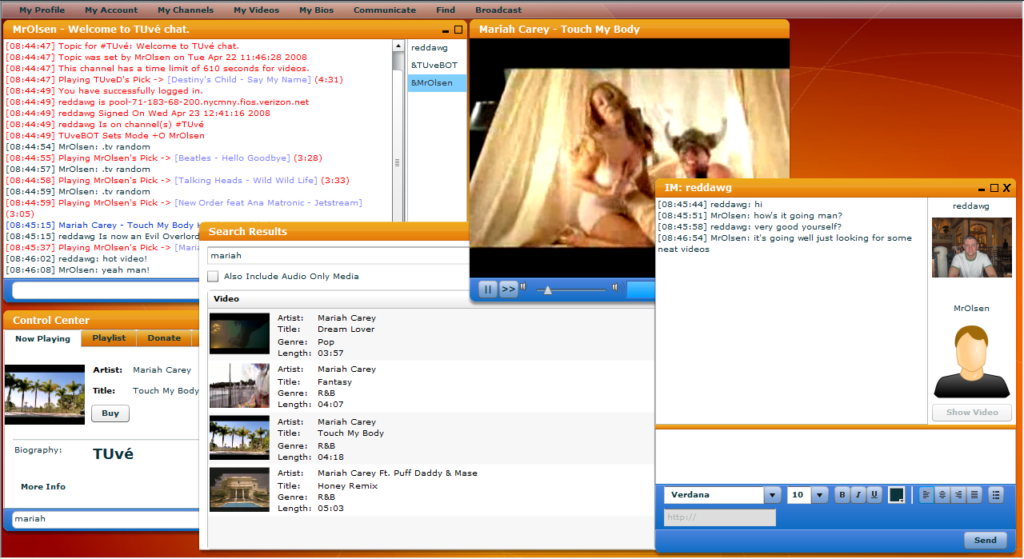
That is exactly what we did — we threw a whole bunch of grease into the fire, and before you could even feel the heat, a simple idea quickly started evolving into a very ambitious platform. With some well-thought-out design and feature planning, back-and-forth IRC chatter, and screenshot mock-ups, we had our first set of features planned. What was once a very basic video player now would have a bunch of new features: chat room, instant messaging, playlists, and more!
Original Mock-up
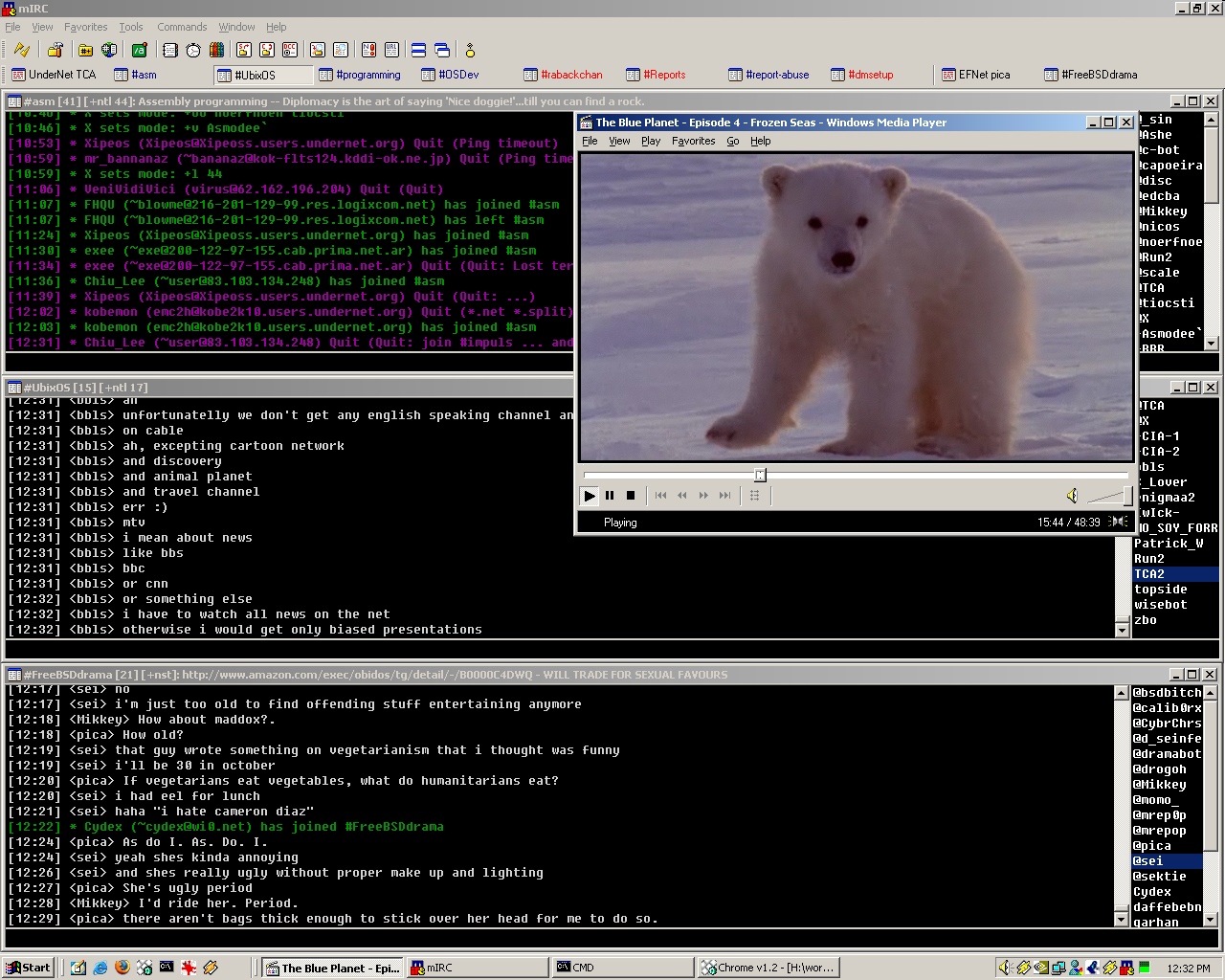
Original Prototype
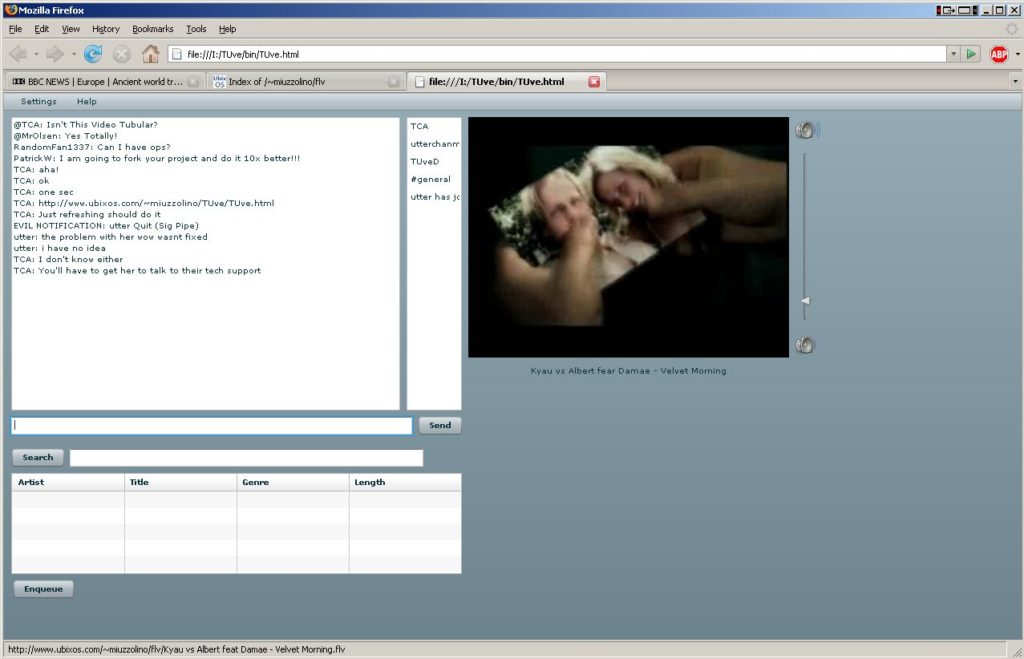
From this point on, there was no turning back — we let the genie out of the bottle and it made no plans to return. Over the next several weeks, we toyed with the interface, took a bazillion attempts at coming up with the perfect encoding algorithm to fit every video in a 400x300 box and look great at no more than 300KB video and 96KB audio, and loaded up over 1,000 videos. I know that doesn’t sound like a lot of videos, but you have to understand — at the time we were using Pentium 4 CPUs in our servers, Intel Core series was just released that year, and internet speeds were in the single Mbit range — so it took some time to get it done.
Here is what our first server looked like — don’t laugh, it wasn’t even a “server,” it was something magical acting as a server.
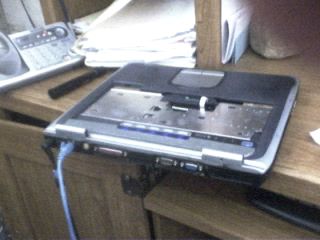
That’s right — it was a laptop with a broken display that was removed and converted to a server. I don’t remember the exact specifications; however, it probably had no more than 2GB of RAM, 120GB of hard disk space, and a mobile Pentium 4 of about 1.2GHz.
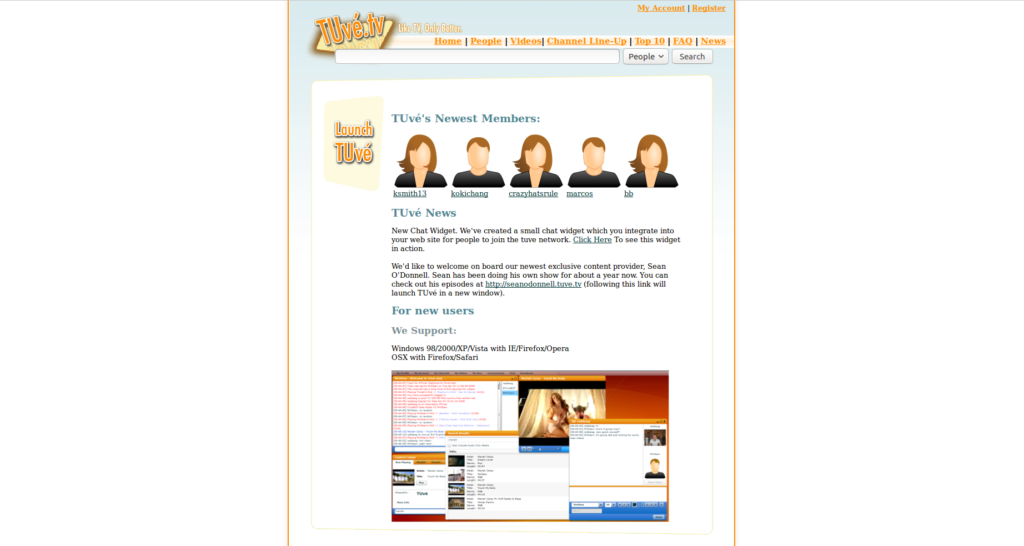
As our library began to fill, our testing became more complete, and our small community shared their enthusiasm — we knew it was time to open up to the public. We polished up the UI to make sure everything flowed, the icons and colors looked right, and it just felt natural. First impressions are everything, and this was as much about beauty as it was about technology. We also recruited a web developer to flesh out a simple site so that new visitors could see what we had going on, see our library and our users, and hopefully entice them to try it out.
Here is our polished UI
This is what our website looked like
Launched!
Now that we had opened our doors to the world, we had to ensure that user experience was always a positive one and find ways to entice them to come back, invite their friends, and find ways in which they could use TUvé in the rest of their online experiences. At the time of launch, TUvé only had a small subset of features available for public consumption — the ones we felt were most important to keep users coming back. Those were chat rooms, private chat, shared playlists, feedback submission, and the ability to upload and manage videos.
We continued to sculpt TUvé as new members joined, listening to their feedback and mixing in our master plan. At first, we focused on the social and communal aspects, adding live video stream, live video overlay, and multiple live overlays to allow users to communicate and enhance the viewing experience. Some of the effect was similar to watching a music video on VH1/MTV where they overlaid a thumbnail-sized video with a quick comment from a comedian. This feature was also used for moderated town-hall-style meetings where the presenter would speak, and then a question or comment could be brought into the stream by a moderator as a live video stream — either as an overlay or a full video window.
As our user base grew from 10 to 20 to 50, we had to keep pace and deliver to our content providers what they wanted. We built in more channel controls — content providers could define parameters for what videos their viewers would be able to play, and whether they wanted to allow videos from outside their content. We also added more advanced features such as scheduling, so the content provider could treat the channel as a network and have scheduled programming outside of live video streams. Most importantly, we created widgets so that our content providers could embed the videos they uploaded into their own websites, similar to what YouTube does. We also provided them with two major widgets to entice them to really utilize TUvé. We created a live stream widget — so all of the video streams you could see inside TUvé you would watch from their site — and if that was not enough, we made a chat widget that would bring guest users into their channel so they could text chat and listen to the audio.
Here is what the chat app, appropriately named ubChattin, looked like.
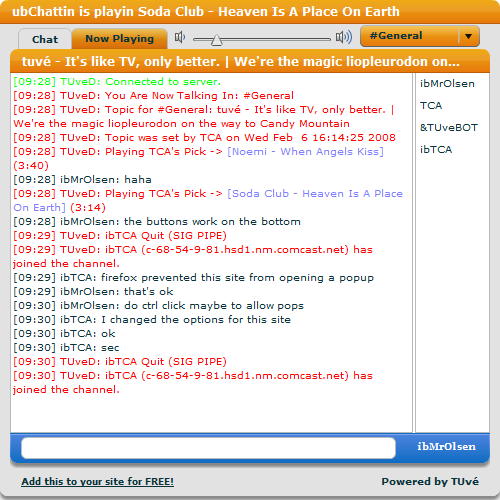
The best part was that the widgets were very easy to configure and deploy, allowing them not only to be added to their website but also to be embedded into their Facebook posts and Myspace profiles. It was always our top priority to ensure that TUvé could reach many and be flexible enough to achieve that goal. We always wanted users to ultimately come onto TUvé for the full experience, and making a trail of breadcrumbs was a good way to do it.
The TUvé Experience
Things were going well — we hit more than 100 users in no time at all — but something was missing. We focused all our initial efforts on delivering all the features that users and content providers needed to use the platform and keep coming back. What we were missing was still the TUvé experience we sold ourselves on: a completely interactive experience, more than just the blending of video streams.
What we needed was a way for our users to really get involved with the channel they were in and have an immersive experience unlike any they had had. Users needed a way to really get involved. If it was a game show, they needed to be part of the show. If it was a contest, they needed a way to vote. If it was a lesson, they needed a way to solve problems together. Anything you could imagine, we had to find a way to make it possible.
Finally, the TUvé widget API was born to allow developers to build third-party modules that could be loaded into TUvé to give content providers features at a pace faster than we ourselves could deliver. Our API allowed any developer to easily tap into the core of TUvé to access all pertinent information, as well as enable the apps they built to have real-time communication so that the app could be used by all the viewers in a shared experience.
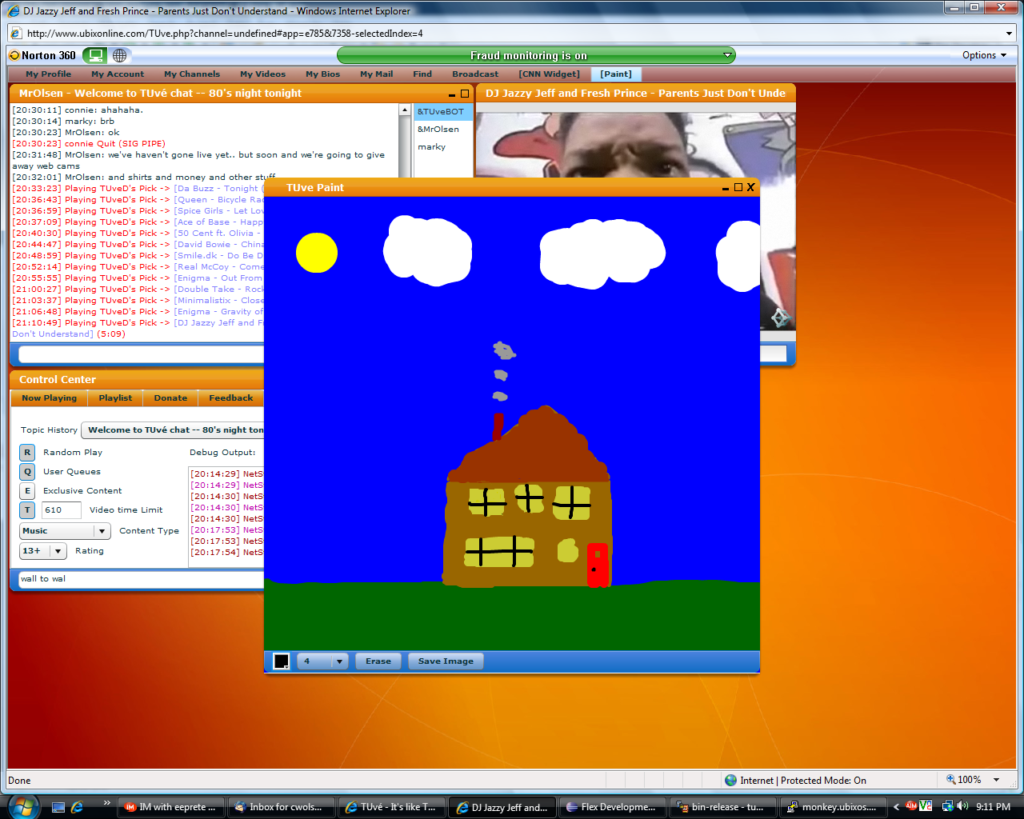
To get the party started, we made a few modules — which we called Widgets — to show off the potential and create some excitement. Here is a Paint program we made: as one person drew in the paint window, it showed up in all of the other open paint windows.
Fade To Black
This is where the story of TUvé ends, making way for a possible sequel, TUvé 2: Born From Ashes.
We peaked with over 200 users, almost 4,000 videos, and many widgets — many exciting moments and happy memories. Being all that it was, without being able to match up with an investor who saw our vision the way we did, we had to ultimately let it limp along for as long as it could. We did not have enough personal resources to keep up with the cost of hardware and co-location, or manage to live without a source of income.
It wasn’t an easy decision to make. We knew what we had — slow but sustainable traction — we just didn’t have the ability to keep it running.
Please share your thoughts — maybe the sequel will come to be.