Sowing.me — A Patreon Alternative Built on uBix Core
From Framework to Product
When I wrote about uBix Core a few weeks ago, I made a claim that’s easy to make and hard to back up: that a framework is only worth anything if a real product runs on it. I called Sowing.me the reference implementation and moved on.
This post is the other half of that story — the product itself. Because “reference implementation” undersells it. Sowing.me isn’t a demo app built to show off uBix Core. It’s a real, in-production membership platform with real creators and real payouts, and uBix Core is simply what it happens to be built on. The framework exists to serve the product, not the other way around.
What Sowing.me Is
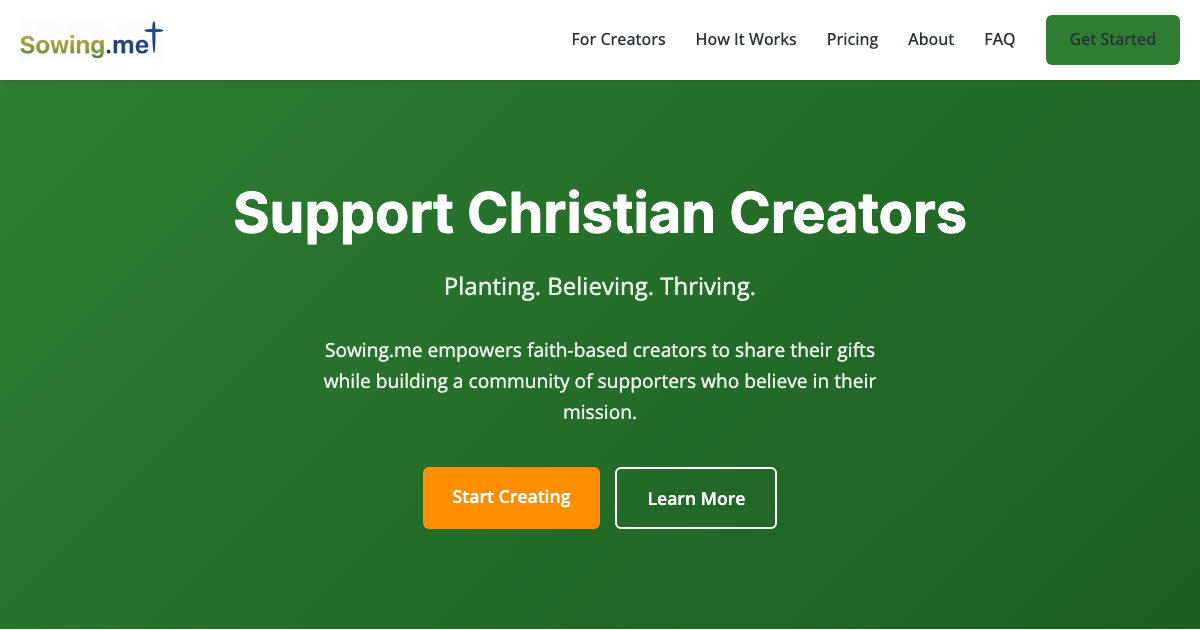
Sowing.me is a membership and monetization platform for Christian content creators — think Patreon, built specifically for a community that has been consistently underserved, and often outright demonetized, on mainstream platforms.
The pitch on the site is three words: Planting. Believing. Thriving. Underneath that is a straightforward two-sided marketplace. Creators publish videos, podcasts, and articles behind tiered memberships. Supporters who believe in a creator’s mission pay a monthly subscription for access. Creators get paid out on a schedule, keep the large majority of what they earn, and — critically — don’t have to wonder whether the platform will quietly demonetize faith-based content or pull the rug out from under them.
That last point is the whole reason it exists. Plenty of platforms can process a subscription. Very few are built by people who consider “a platform that respects and supports Christian creators without censorship of faith-based messaging” a core product requirement rather than a liability.
What It Actually Does
Under the marketing, it’s a full creator-economy platform:
- Membership tiers — creators define subscription levels with distinct benefits and exclusive content per tier.
- Content gating — videos, podcasts, and articles published behind the tiers a supporter has paid for.
- Sustainable income — recurring monthly memberships with scheduled payouts, so creators can treat it as a real income stream, not tip-jar noise.
- Direct connection — messaging and community features so creators engage supporters directly, not through an algorithm.
- Growth tools — analytics and promotional tooling so a creator can actually see and grow their impact.
- Creator-friendly terms — competitive, transparent rates with no hidden fees; creators keep more of what they earn.
The onboarding is deliberately three steps — create your page and define your tiers, publish your content, then grow your supporter base and receive income — because friction at signup is where creator platforms lose the exact people they’re trying to serve.
Why This Is the Real Test of uBix Core
Here’s the part that matters to me as an engineer. A two-sided marketplace is one of the most demanding things you can build, because it exercises everything at once:
- Billing and subscription lifecycle — recurring payments, tier changes, payouts, the states in between. This is where sloppy data modeling goes to die.
- Access control on every request — is this supporter entitled to this piece of content, right now, at this tier? Content gating is authorization applied thousands of times a day.
- Two distinct frontends’ worth of flows — the creator’s publishing/analytics side and the supporter’s discovery/subscription side, sharing a domain but almost nothing else.
- Operational reality — migrations, deploys, and background work running in production against real money and real users.
That is exactly the workload I built uBix Core for. Sowing.me runs on the framework’s Repository Pattern with DTOs and strict data types (billing logic is not a place for raw strings and stray ints), its Slim 4 + PHP-DI API layer keeping controllers thin, a Svelte 5 / SvelteKit frontend that shares nothing with the PHP layer but HTTP contracts, and the CLI that runs its migrations and deploys. All of it in one monorepo, versioned together, so the API and the frontend can never drift out of sync — which is the entire point of the monorepo discipline when real money is moving through the system. It’s deployed in Kubernetes, backed by MariaDB.
Building Sowing.me is what turned uBix Core from a set of patterns I believed in into a set of patterns I’ve tested under production load. Every place the framework was awkward to use, I felt it here first. That feedback loop — build the framework, build a real product on it, fix the framework where the product hurts — is why I trust uBix Core enough to open-source it.
Two Things, One Codebase
The honest summary is that Sowing.me and uBix Core are the same effort viewed from two ends. One is a mission — help faith-based creators build sustainable ministries without fear of demonetization. The other is the engineering that makes that mission real and keeps it maintainable. Neither is a demo of the other; they ship together.
The platform is live at sowing.me, and the framework underneath it is open source at github.com/cwolsen7905/uBixCore. If you want to see what uBix Core can do, don’t read the code first — go use the product. Then read the code and realize they’re the same thing.