Planet Merge — A Drop-and-Merge Puzzle Game Built With Godot and Claude
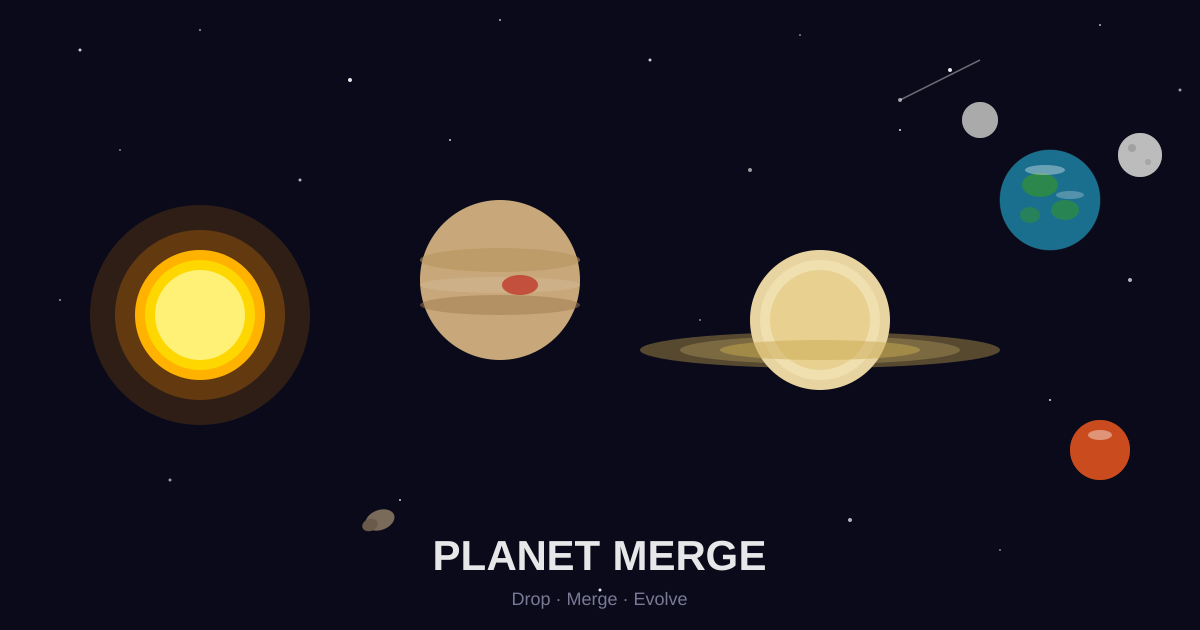
Planet Merge is a casual drop-and-merge puzzle game — think Suika Game, but with a space theme. Drop planets into a container, merge matching ones to evolve them into larger celestial bodies, and try not to let the pile reach the danger line.
The planet tiers run from Asteroid at the bottom through Meteorite, Moon, Mercury, and Mars — which can be dropped — up to Earth, Neptune, Saturn, Uranus, Jupiter, and finally the Sun, which can only be obtained by merging. Getting a Sun is worth a 500-point bonus on top of the merge score.
Physics and Feel
The game runs on Godot’s RigidBody2D physics with tuned bounce, friction, and damping values. When two planets merge, a shockwave pushes nearby planets outward — which matters strategically, since the push can save you from an overflow or create a cascade you weren’t expecting.
Planets have procedurally drawn organic blob shapes using sine wave deformation, unique per tier. They have animated faces (idle, falling, hit, merge states) pulled from a sprite sheet with a custom shader for rendering. Saturn has animated rings. Jupiter has cloud bands. The Sun has a radiant glow.
The background is an animated starfield with random comets and meteors. It’s a small thing that makes the game feel alive when you’re thinking about your next drop.
Scoring
Every merge scores tier² × 10 points. A Moon merge (tier 3) is worth 90. An Earth merge (tier 6, merge-only) is worth 360. A Jupiter merge (tier 10) is worth 1,000. The Sun (tier 11) scores 1,210 from the formula plus 500 bonus — but getting there requires enough merges that the point values below it have already accumulated.
High scores persist between sessions via user://highscore.dat.
Built With Claude via MCP
The most interesting part of Planet Merge isn’t the game — it’s how it was built.
The repo includes a TypeScript/Node.js MCP (Model Context Protocol) server and a Godot editor addon that acts as a WebSocket bridge. Claude connects to the MCP server over stdio; the MCP server forwards tool calls to the Godot editor addon over WebSocket on localhost:9080; the addon executes commands against the live Godot API.
The effect: Claude can read and modify scripts, scenes, and nodes in the Godot project in real time, while the editor is open. You describe what you want, Claude writes the GDScript, and the change lands in the editor without copy-pasting. The Godot MCP addon was built as part of this project.
This isn’t the same as asking an AI to generate code and pasting it in. The AI has live context — it can read the current state of the scene, inspect node properties, make targeted edits, and iterate. It’s closer to pair programming with a tool that has direct editor access.
The game itself is the proof of concept. It’s playable, it has physics and scoring and persistence, and it was built in a fraction of the time the same project would have taken without the integration.
GitHub: cwolsen7905/PlanetMerge