UbixOS 3.1.0 — It Builds Itself Now

UbixOS 3.1.0 is out, and the headline is the one I’ve been working toward for a long time: UbixOS builds itself.
On both supported architectures, aarch64 and x86_64, UbixOS compiles its own kernel and userland inside UbixOS, the redesigned desktop included. The same desktop described below now runs on a system that builds itself. An image made from that output boots on the self-built kernel and passes sigtest and vfstest, the signal and filesystem test programs I use as the gate.
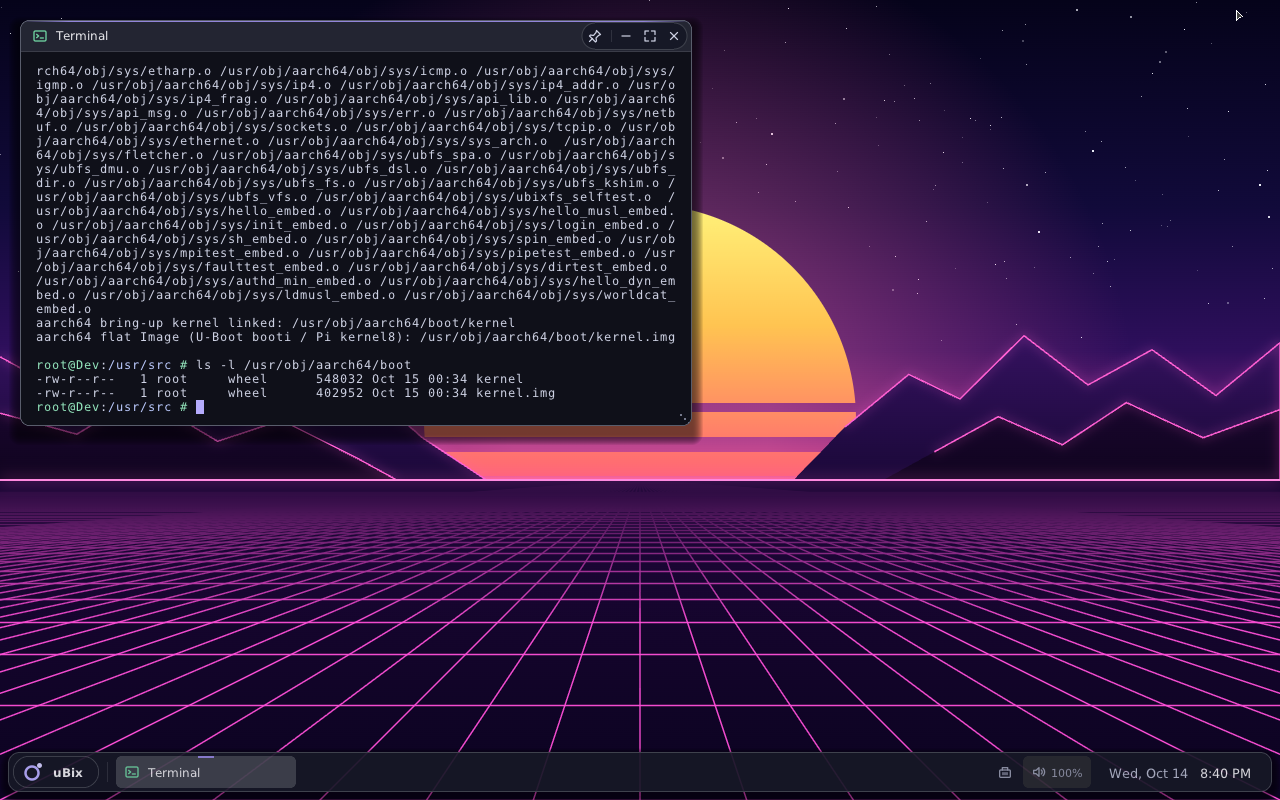
Self-hosting
| aarch64 | x86_64 | |
|---|---|---|
In-OS bmake -j4 world (clean, 4 vCPUs) | passes, 3h44m | passes, 9h48m (QEMU TCG) |
In-OS bmake -j4 kernel | passes | passes |
Self-built kernel boots; sigtest + vfstest | pass | pass |
Image made only from the in-OS build output boots; sigtest + vfstest | pass | pass |
The x86_64 number is long because it ran under QEMU’s software emulation (TCG), not hardware acceleration. It’s a correctness result, not a speed result.
What it took
None of this was one big change. It was a chain of small things that each had to be true:
- musl builds with
bmake. The musl libc now has a BSD makefile that builds the same 1,355 objects with the same flags as the GNU build, so/usr/src/libbuilds in-OS with the BSD toolchain. - Bare in-OS
clanglinks programs.crtbeginS.oandcrtendS.onow come from compiler-rt and are staged into/lib, soclang -o h h.cjust works inside the OS. - A page leak, fixed.
mmap(MAP_FIXED)over a live page dropped the old frame without freeing it, and musl’s allocator did that once per process. Roughly 4 KB lost per process on aarch64 and 1.36 MB per 300 on x86_64. A long build is exactly the workload that finds this. 500lson aarch64 now leaves memory use flat. - Programs linked in-OS are executable.
open(O_CREAT)applies the mode,chmodandfchmodwork,renameis an atomic native entry move, andO_EXCLgivesEEXIST. There’s also a real per-taskumask(2). /bin/shandbmakeare built byworld.okshandbmakeare vendored incontrib/, so a world built inside UbixOS rebuilds its own build tools.
The new desktop
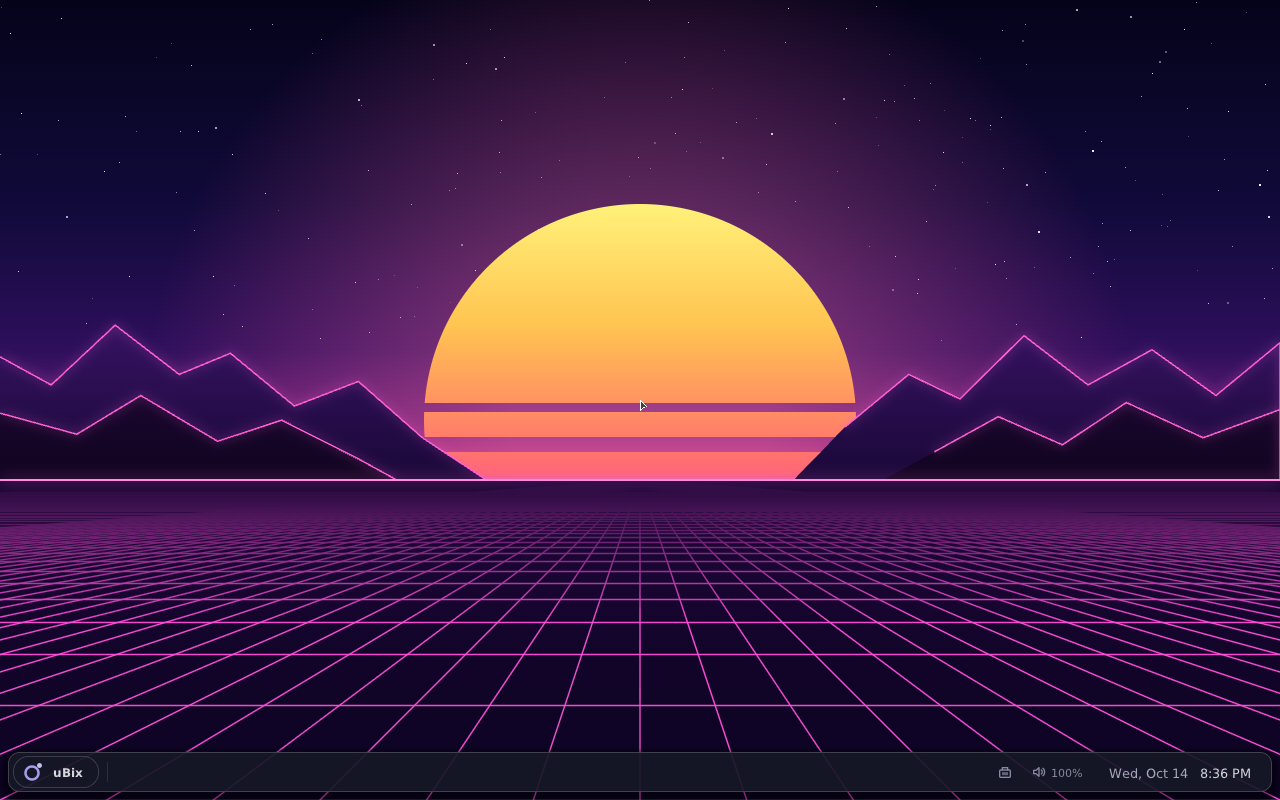
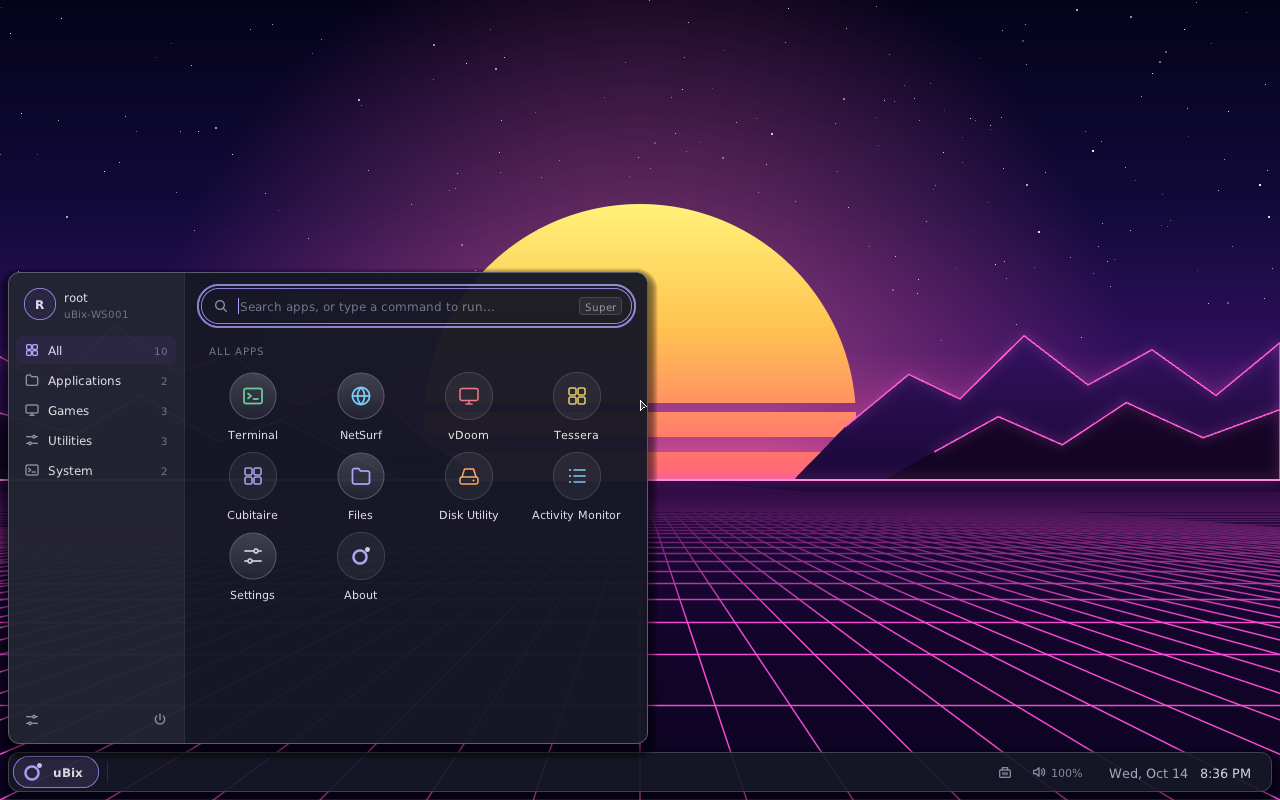
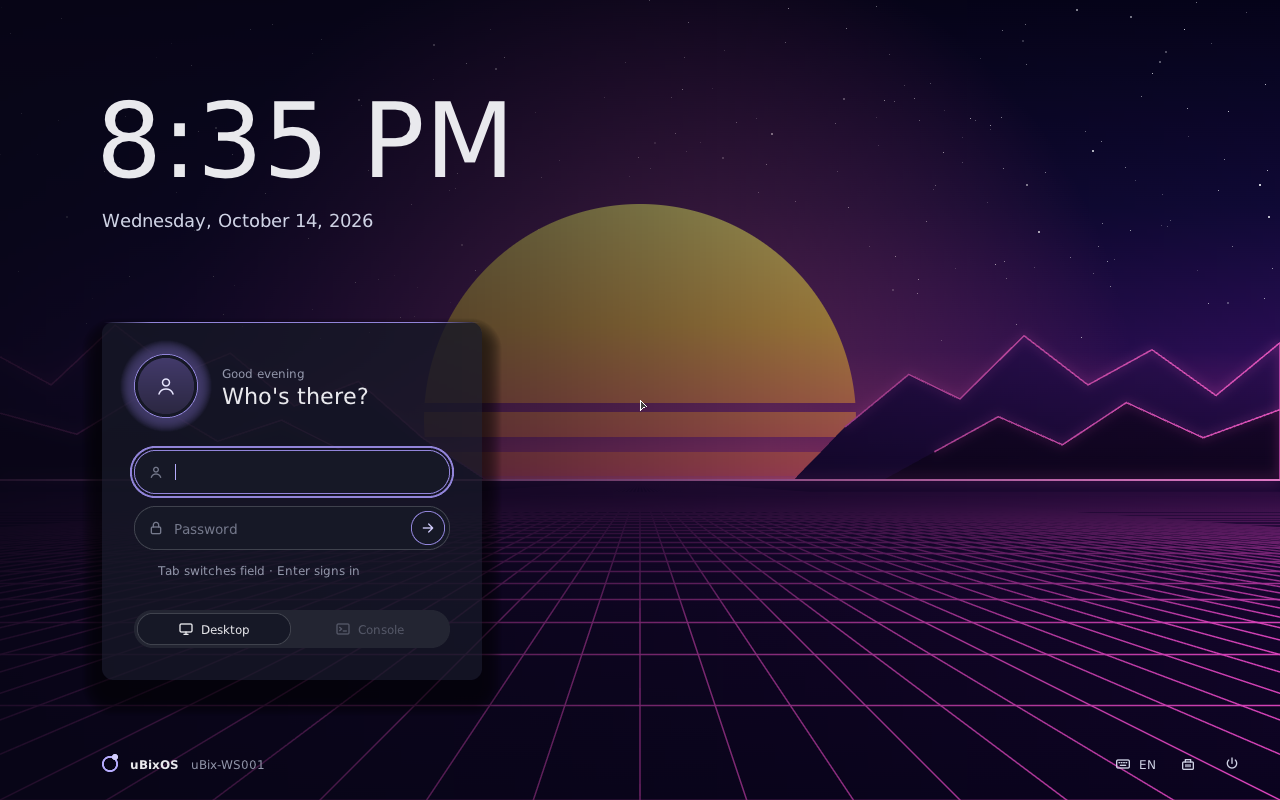
3.1.0 also carries the “ubixos-v2” desktop redesign, drawn first as interactive mockups and then built for real. It’s the same on both architectures.
- Light and dark modes. A shared theme with both palettes, switched OS-wide at once. Apps can opt out; the terminal stays dark.
- A per-user accent colour, chosen in Settings and used across the desktop, Alt-Tab included.
- A new window frame. A pin button, and minimize, maximize and close grouped in one capsule. Windows resize from any edge or corner and stack in proper layers.
- A floating, translucent taskbar replaces the old Windows-11-style one.
- A launcher replaces the cascading start menu: app categories, search, recent items and a power menu. The Super key opens it on both architectures.
- Flyouts for calendar, volume and network status. The kernel gained a small call that reports link state and IPv4 address for this.
- A new lock screen, drawn from the design.
- Real power-off and restart from the desktop. The power menu asks init, which syncs the disks and then powers off or reboots: PSCI on ARM, ACPI power-off on x86_64 with keyboard-controller and fallback resets.
- Smoother drawing. Shared helpers draw anti-aliased shapes and icons, windows can be per-pixel translucent, and there’s a new icon set at 16, 24 and 48 px and a new wallpaper, “Nocturne”.
Settings (with a new Appearance page), Files, the activity monitor, Disk Utility and the Terminal’s palette were restyled to match.
Honest limits
I’d rather you hear these from me:
- The in-OS toolchain is LLVM built on the host. UbixOS runs Clang and lld inside itself, but it didn’t build them. The whole-image test also used host-built
shandbmake;worldbuilds those itself now, but that test predates the change. - NetSurf is skipped in-OS. It’s a port that needs GNU make.
mkdirignores its mode. Directories are always 0755.- Stage
/usr/srcfirst. Re-stage it before an in-OS build, or the in-OS libc is built from stale sources. - Desktop things dropped for now: taskbar hover previews and the Files details view with its editable address bar. They may come back.
- Multi-CPU came later. The redesign was verified on one CPU per architecture at first, because a multi-CPU messaging bug blocked login. Kernel fixes since resolved that, and the desktop now boots to the login screen with 4 CPUs on both architectures in the test VMs.
What’s next
A widget toolkit. Apps still hand-draw their controls, and I want that to stop.
An installer. The plan is a UEFI loader for both architectures, GPT disks, a live image you can boot and install from, text installer first and a graphical one on the same library after. VMs first, real PCs later. It’s written up as a design and a build plan, and none of it is built yet.
The full release is in the changelog.